
In appreciation of Peter Linsky’s July ’25 Anzeiger article regarding “frit” on automotive glass, I thought it was prudent to research and explore some of the other automotive markings often found on auto glass.
If you look in the corner of your front windshield, side windows, or rear window glass, you may notice a combination of black symbols, numbers and letters. This “stamp” is commonly referred by those in the automotive glass industry as a “bug.” This bug provides helpful information regarding the glass in your vehicle. Here are some common designations in the bug, as we read from top down and from left to right using local vehicle examples;
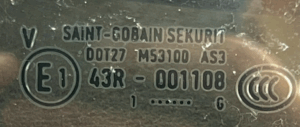
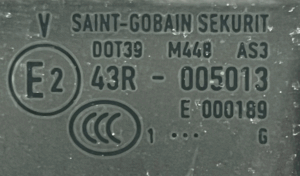

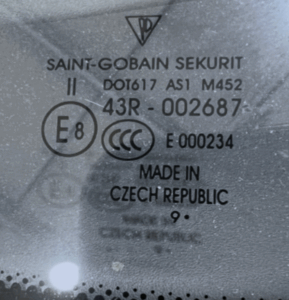
- Auto glass manufacturer—Often below the vehicle manufacturer’s logo (if present), you’ll find the logo of the glass manufacturer. For example, you may see the Porsche logo with the Saint-Gobain Sekurit company logo below it. Saint Gobain-Sekurit is one of the auto glass manufacturers that is contracted by Porsche.
- Subtype of glass—This designation notes specifics about the glass and is displayed in Roman numerals. II means the glass is laminated/multi-layer, whereas V means the glass has less than 70% light transmittance. Here are other subtype designations; I means the glass is toughened and extra durable, III means the glass is a laminated/multi-layer which has been treated to increase its strength such as for wind resistance, IV is in regards to glass-plastics, VI means the glass has less than 70% light transmittance but is double glazed, VII means the glass is only for vehicles which cannot exceed 40 km/hr, VIII is for glass with rigid plastic glazing that doesn’t deflect vertically more than 50mm, IX is for glass with flexible plastic glazing which deflects vertically more than 50mm, X is for rigid plastic glass which is comprised of multiple glazed units, XI is for laminated glass not used as a front windshield.
- Federal Department of Transportation (DOT) number—All pieces of glass should show the DOT number that the specific glass manufacturer is registered under. DOT27, DOT39, and DOT617 are examples.
- Safety test standards—This is a designation of impact and light transmission standards, under federal regulations. AS1 is for laminated glass which is impact-resistant and shatterproof (typically used for front windshields), with a minimum light transmission of 70%, meaning that it’s relatively clear and best for use in adverse weather or low-light driving situations. You might also see a line and arrow near the AS1 script. Glass above this line may have or may allow for darker tint than the remainder of the front windshield. AS2 is for use in locations on a vehicle other than the front windshield. It is single pane and usually tempered, which means it has been treated to shatter into small and harmless pieces if broken (car prowlers approve of AS2). Like AS1, AS2 must allow for at least 70% of light to pass through it. AS3 on the other hand, allows for light transmittance below 70%, so this glass is not permitted for use in front windshields. AS3 is often referred to as privacy glass and is used in the rear-most side windows and/or rear windshield. “AS” stands for American Standard, which are standards and regulations set forth by the American National Standards Institute (ANSI). AS1, AS2, and AS3 are examples.
- Manufacturer’s part number—Usually to the right of the DOT number will be the manufacturer’s part number. This allows them to identify traits of the glass; glass structure, thickness, manufacture technology, even shade or tone. First two digits refer to glass thickness, last digits refer to the tone of the glass. MXXO refers to clear glass, MXX1 refers to green tinted glass, MXX2 refers to bronze tinted glass, MXX3 refers to blue tinted glass, currently unsure what tint MXX8 refers to. M35, M448, M452, and M53100 are examples.
- Country of distribution and/or certification—You may see a round circle with a letter in the center. For our Porsches, you’ll probably see an E, E1, E2, maybe an E8. This means the glass is approved for distribution in Europe (E), in Germany (E1), in France (E2), or in the Czech Republic (E8). Here are other country designations; Italy (E3), Netherlands (E4), Sweden (E5), Belgium (E6), Hungary (E7), Spain (E9), Serbia and Montenegro (E10), United Kingdom (E11), Austria (E12), Luxembourg (E13), Switzerland (E14), Norway (E16), Finland (E17), Denmark (E18), Romania (E19), Poland (E20), Portugal (E21), Russia (E22), Greece (E23), Ireland (E24), Croatia (E25), Slovenia (E26), Slovakia (E27), Belarus (E28), Estonia (E29), Bosnia and Herzegovina (E31), Latvia (E32), Turkey (E37), Azerbaijan (E39), Former Yugoslav Republic of Macedonia (E40), European Community (E42), Japan (E43), Australia (E45), Ukraine (E46), South Africa (E47), New Zealand (E48), Cyprus (E49), Republic of Korea (E51), Malaysia (E52), Thailand (E53). CCC means that the glass is also distributed in China. This country code is followed by a code for the approval/certification type. Examples are 43R-000677, 43R-001108, 43R-002687, and 43R-005013.
- Date of Manufacture—The bug will often contain the month and year that the windshield was manufactured. This information is tricky to decipher however since there is no common format on how this information is displayed. . . . 7 is supposed to mean April 2007 manufacture date. Examples are 9. (most likely some time in 2009), 1. . . (most likely some time in 2011), 1. . . . . . (most likely some time in 2011).
- Currently unsure what the other E and numbers represent, other than another European standard. Examples are E000184, E000189, and E000234.
- Vehicle manufacturer—If the windshield is original, it may have the vehicle manufacturer’s logo in the top of the bug.
- Model name of the auto glass—Sometimes below the DOT number, you may find the specific type of glass the windshield is comprised of. “Laminated,” “Lamisafe,” or “Lamipane” indicates that it is a laminated auto glass. “Tempered,” “Temperlite,” or “Therlite” indicates that the windshield is tempered glass. “Tintex” indicates the windshield is slightly tinted.
There may be additional symbols seen on some automotive glass, which have been added by the specific glass manufacturer in order to note special features. Some may include;
- Hammer symbol—This icon is used when the windshield has an increased impact-resistance feature.
- Ear-shaped symbol—This means the glass has a noise absorption feature.
- Raindrops symbol—This indicates the windshield has a water-repellent treatment which has been added to the glass.
- Round circle with “iR” inside of the circle—This is a designation which means that the glass, typically a front windshield, is made of chameleon athermal glass. This glass usually has a slight purple hue, also has polyvinyl butyral film between two layers of glass, as well as a layer of transparent silver film. These features combine to dissipate approximately 70-75% of the heat radiated from direct sunlight.
- Thermometer symbol—This icon is used when the athermal glass has a sun-reflective coating added to it. Additionally, if the symbol also has the letters “UU,” this means the windshield has an UV filter as well.
- Double-sided arrow—This symbol indicates the athermal glass has an anti-reflective coating applied to it.
If you need your windshield or other piece of glass replaced, here is some general information on the three main offerings you’ll find on the market;
- Dealership glass—This glass is the replacement for what was used when your vehicle was originally manufactured on Porsche’s assembly line, and is made by the company that Porsche contracts to for automotive glass. The quality, fit, and finish meets Porsche’s strict specifications. The Porsche logo will usually be etched on the glass, which is important for those restoring a vehicle. For all of these reasons, dealership glass often comes at a premium price point.
- OEM (Original Equipment Manufacturer) glass—This glass is very similar to dealership glass. It is manufactured to the same specifications as dealership glass, but is probably not made by the same company Porsche contracted dealership glass to. Thus, OEM glass will not bear the Porsche logo and hence, will be slightly less expensive than dealership glass.
- Aftermarket glass—This glass is usually manufactured to required safety requirements, but it may not match OEM or dealership glass in terms of composition, thickness, color, fit, or other attributes. Aftermarket glass is by far the lowest cost option for these reasons.
Hopefully now you’re equipped with a bit more automotive knowledge, and some fun facts for your next trivia game.
If you have any questions regarding this topic, please feel free to ask. No question is a silly question.
Jeremy Williams is the Oregon PCA Technical Editor. He co-owns Matrix Integrated (Matrix Integrated Inc.) with his brother Justin. Jeremy can be reached at [email protected]